When One Hail Event Hits Three Buildings: How Remodlr Pro Untangled a $500K Commercial Claim
A public adjusting firm walked into our office—virtually—with a problem. They had just taken on a commercial hail and wind claim from a property owner representing a small borough in western Pennsylvania. A single severe weather event, ranked #1 in local hail history, had struck a three-building commercial campus. Tennis-ball-sized hail (2.5 inches), 60 mph wind gusts, and three separate buildings with three separate occupancy types. The scope was massive. The timeline was tight—the loss date was nearly a year prior, putting the firm under real pressure to organize, vet, and submit the claim file correctly.
They had the raw materials: three Xactimate estimates totaling roughly $500,000 in combined replacement cost value. Three CompanyCam photo reports documenting the damage field-by-field. A 73-page carrier insurance policy (OCR transcription of a scanned PDF). A weather evidence summary. But no organized claim file. No reconciliation. No master narrative.
They needed to know what they had, what it all meant, and whether it would survive carrier scrutiny.
That's when they brought it to Remodlr Pro.
The Claim: Three Buildings, One Storm, One File
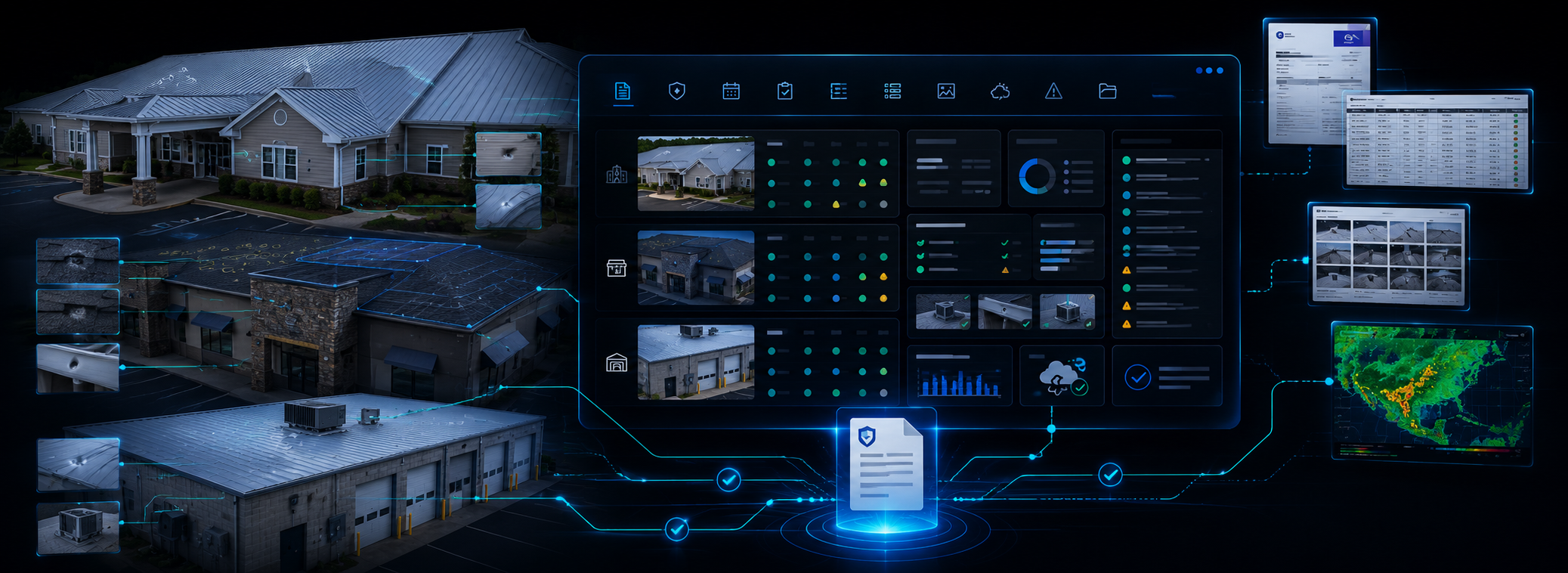
The property was a commercial campus—three distinct structures:
- Building 1: An institutional/senior care facility with a metal roof and vinyl siding
- Building 2: A commercial service building with asphalt shingle roofing and composite exterior
- Building 3: A light-industrial structure with metal roofing and concrete block walls
The storm on the reported loss date produced seven ground-truth hail reports within the borough, NWS-issued severe thunderstorm warnings naming the county by name, independent video documentation from storm chasers, and property impact modeling showing 6,379+ properties affected across the county. The weather case was strong.
But the documentation wasn't.
The Problem: Address Chaos
Here's where things got complicated—and where most manual claim reviews would stumble.
Across the three estimate files and three photo reports, addresses were referenced inconsistently. One estimate's project ID said "1228" while its property address field said "1222." A CompanyCam cover page showed one building name; internal photo pages showed another. Estimates referenced different addresses for the same building. One building appeared to be missing from the policy entirely.
This wasn't a minor typo. Submitting mismatched evidence to a carrier is a claim-killing problem. Carriers flag address inconsistencies as red flags for fraud or documentation failure. The PA firm knew they couldn't send a file forward with these conflicts unresolved—but manually cross-referencing six documents to build a true building identity map is tedious, error-prone work.
Remodlr Pro built a systematic reconciliation table across all documents:
- Flagged every address reference by document type and specific page/field
- Assigned temporary working labels to distinguish buildings during analysis
- Identified which conflicts were data-entry errors vs. which might indicate a fourth, uninsured building
- Specified exactly what needed to be confirmed in the field before submission
Then the policy was uploaded.
The moment Remodlr Pro parsed the carrier's declarations, the mystery resolved: the policy listed only three insured addresses—the three correct ones. The "phantom" fourth address that had caused so much confusion in the estimates and photo reports didn't exist on the policy. It was simply a working label applied to what was actually an insured building under one of the three covered addresses.
What would have taken a human adjuster 2–3 hours of document review and phone calls took minutes. The address mapping question was settled definitively by the source of truth: the policy itself.
The Policy Period Problem
Then Remodlr Pro flagged something critical: the policy uploaded was a renewal certificate for the period following the loss date. The actual date of loss fell in the prior policy period—nearly a year earlier.
This mattered because coverage terms, limits, deductibles, and exclusions can change from renewal to renewal. Submitting a claim against the wrong policy period is a disqualifying error.
The PA firm needed to obtain the prior-period declarations immediately. Remodlr Pro flagged this as a blocking item, prioritized it, and explained exactly why it mattered.
Estimate QA: What We Found (And What Was Missing)
This is where the analysis shifted from organizational to technical. Once the documents were properly mapped and verified, Remodlr Pro ran a full estimate quality assurance pass across all three files.
What we found:
Probable triple-count on metal roofing. One building's estimate showed three separate line items (91, 92, and 93)—all pricing the same 5,317 square feet of metal roofing at different rates. The exposure: approximately $50,000 in potential overstatement that a carrier claims adjuster would immediately challenge.
A cleaning line item that didn't math. A "final cleaning" scope of 47,655 square feet appeared in all three estimates. The actual building footprints were 6,000–12,000 SF each. This single line item represented approximately $30,000+ in potentially unsupported charges across the file.
Rubber roofing with no photo support. One building's estimate included $26,534 in rubber membrane roofing scope. The photos showed a metal roof, not a rubber membrane. The mismatch needed resolution.
Labor efficiency misclassification. Residential labor rates were applied throughout, despite these being commercial buildings. Carriers consistently challenge this.
Roof measurement inconsistencies. One building's roof was priced at three different square-footage totals (87.36 SQ, 93.51 SQ, and 105 SQ) with no explanation of which was correct or why.
What we didn't find—the scope gaps:
Remodlr Pro also identified significant scope that the estimates had omitted despite clear photographic documentation:
- Vinyl siding damage on Building 1: Zero scope included, despite photos showing punctures, cracked panels, broken seams, and chalk-marked hail damage across multiple elevations. Estimated missing scope: $15,000–$25,000.
- Gutter and fascia damage across all buildings: No scope included for gutters, downspouts, soffit, or fascia damage despite visible chalk-marked damage on the photo reports. The carrier's policy actually included a powerful siding/roofing restoration extension that covered replacement of ALL undamaged siding and roofing materials on a building if the damaged material was no longer available in matching form. This extension could support a full-perimeter siding replacement rather than partial repair—significantly strengthening the supplement.
- Interior scope on the occupied facility: The senior care building showed evidence of roof hail damage and water intrusion risk, but the estimates included zero interior scope. Potential missing scope: $10,000–$50,000+, depending on the extent of water damage investigation.
- HVAC condenser documentation: Multiple rooftop units were visible in photos with chalk-marked damage, but no HVAC scope appeared in the estimates.
The Bottom Line: $80K–$120K in Exposure
Across all three estimates, the combined as-estimated RCV was approximately $499,783.
After Remodlr Pro's quality assurance analysis:
- Unsupported or duplicated line items represented an estimated $80,000–$120,000 exposure (items that would likely be challenged or reduced by the carrier)
- Identified scope gaps on the conservative side represented $35,000–$80,000+ in potentially legitimate damage that hadn't been submitted
Net effect: The file needed significant correction in both directions before carrier submission—and none of it was obvious from reading the individual documents in isolation.
Coverage Limits: A Bright Spot
When Remodlr Pro analyzed the policy against the claim value, one thing became clear: no coverage limit concerns. The combined building limits totaled $2,795,000 across all three buildings, well above the as-estimated claim of ~$500,000 (or ~$380,000–$430,000 after corrections).
The policy also carried a single $5,000 property deductible per occurrence—not per building. For a single hail event affecting all three buildings, the total deductible was $5,000, not $15,000. The 80% coinsurance clause wasn't a concern either; the limits-to-value ratio was favorable.
One Session, 11 Deliverables
In a single analysis session, Remodlr Pro produced:
- Full Master Claim Analysis (11 deliverables including ASA Mini claim summary, per-building scope summaries, damage-to-estimate reconciliation by trade, estimate QA flags with line-item citations, AHJ/local code/permit analysis, weather verification with public sources, carrier vs. insured position table, and missing evidence checklist)
- Erie Policy Coverage Crosswalk (policy parameter extraction, coverage applicability by scope line, deductible and coinsurance analysis, exclusions relevant to the claim, siding/roofing restoration extension analysis, policy period issue flagged, mortgagee interest verification)
- Revised address mapping table resolving all cross-document conflicts with confidence levels and recommended building IDs
- Prioritized action list (blocking vs. non-blocking items) across all three buildings with specific next steps for the PA firm
What This Demonstrates
This claim file is a real-world example of the kind of work Remodlr Pro is built for:
- Complex multi-building claims where document mapping and address reconciliation can easily fail
- Mixed document types (estimates, photos, policy, weather evidence) that need to be cross-referenced
- Time pressure: The PA firm was under deadline to organize and submit correctly
- High-dollar exposure: A single missed deductible provision, wrong policy period, or $50,000 line-item duplication can define the claim outcome
- Manual vs. AI review: This is work that a single human adjuster could spend 8–12 hours on, or that Remodlr Pro can systematize in minutes
The goal isn't to replace human judgment—it's to organize the evidence, flag the conflicts, reconcile the documents, and give the professional adjuster a clear, evidence-mapped foundation to work from.
Ready for Your Next Commercial Claim?
Whether you're managing a three-building campus or a single-structure loss, complex claims require organized evidence, careful reconciliation, and thorough quality assurance before submission.
Remodlr Pro handles the systematic work so your team can focus on the professional judgment.
Visit remodlr.ai to get started on your next claim file.
Remodlr Pro is a claim documentation and analysis platform for construction professionals, public adjusters, insurance contractors, and loss adjusters. All sensitive data in this case study (owner names, PA firm identity, specific addresses, policy numbers) has been redacted to protect client privacy. Building descriptions, construction types, and damage patterns are presented for educational purposes only.